Medical device brand strategy in 5 steps: build the message before the logo
Most rebrands start with a logo and end with the same confusion. These five steps put the message first, so the logo, the website and the booth all say the same thing.
- Topic
- Brand and messaging
- Written by
 Guillaume Viallaneix
Founder and President, MedTech Momentum- Revision history
- APublishedBRewritten and updated
- Reading time
- 6 minutes
- Share
A medical device brand strategy decides what your company stands for, who it is for and how that shows up everywhere a buyer meets you. Build it in this order: the buyer, the message, the proof, the identity, then the rollout. The logo comes near the end.
I first wrote this post in 2024 around color meanings and font styles. The order matters far more than the palette, so this version is about the order. It draws on 11 years as Intech’s marketing partner, from 2014 to 2025.
1. Who is the brand for?
Name the buyers who matter most and what you want each of them to do. For a contract manufacturer, that usually means the engineers, sourcing managers and quality teams at OEMs. For a device company, it means clinicians, the hospital teams that approve new products, and distributors. Write the list down, because every later decision gets checked against it.
2. What is the one sentence?
Write one sentence that says what you make, who it is for and why they should believe you. Your sales team should be able to say it without notes. Everything else in the brand, from the tagline to the website headline, comes from that sentence.
For a manufacturer, the sentence usually rests on capabilities and reliability. For a device company, it rests on the clinical problem you solve and the evidence that you solve it.
3. What can you prove?
List the proof behind the sentence: certifications such as ISO 13485, the OEMs or hospitals you already serve, your clinical data and your cleared indications. Anything you cannot prove comes out of the sentence before a designer sees it. In medical devices, an unsupported claim weakens the brand and can also create a compliance problem.
4. When do the name, logo and colors come in?
Now. With the buyer, the sentence and the proof settled, the design brief almost writes itself. Keep the system small, with one or two typefaces and a limited palette where each color has a job. Make sure the logo still reads at the size of an email signature or a mark on an instrument. Then put the rules in a brand guide, so the next brochure looks like the last one.
How did Intech bring six companies under one brand?
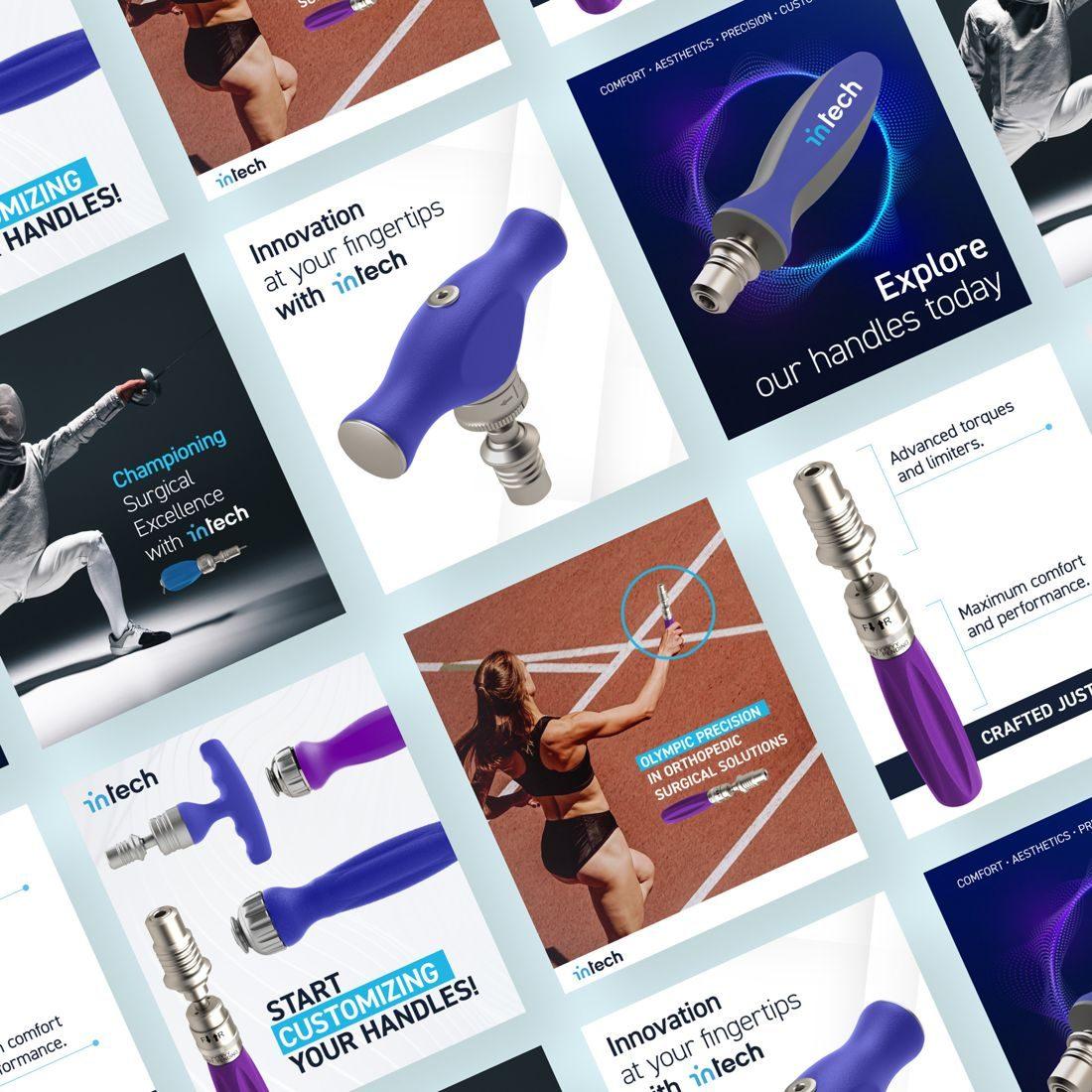
Intech grew through acquisitions: Turner Medical, Ortho Solutions, Pyxidis, Bradshaw Medical, Coulot Decolletage and Lenkbar. Customers saw six names and six stories. Our work across those years was to give them one brand story, then carry it into the booth, the sales materials and the rebrand of each company as it joined. We were also part of the design team on the 2018 Intech logo.
 2014
 2018
In 2025 the group became EXALTA, and our partnership ended with that change.
5. How do you roll the brand out?
Everywhere at once, starting with the people who talk to buyers. Brief your sales team and distributors before anything goes public. Then update the website, sales decks, LinkedIn, email signatures and trade show material, and change labels only through your regulatory process. A half finished rollout tells buyers you are two companies.
What mistakes do companies make with a medical device brand strategy?
The one I see most is starting with the logo. A new identity on top of an unclear message gives you a better looking version of the same confusion, and it is expensive to redo once it is on booths, decks and packaging.
Another is letting every product or acquired company keep its own story. Buyers then have to work out how the pieces fit, and most will not try. One company story, with products under it, is easier to sell and easier to remember.
The costliest in our field is writing claims that marketing cannot support. If your regulatory team strikes a line from the brochure, it should never have been in the brand sentence. Bring regulatory into step 3, before the design work starts, and you avoid most of the rework.
If your company has grown through acquisitions, or your brand no longer matches what you make, start with step 2. Our brand and messaging work starts there too, and my piece on healthcare storytelling covers how to turn the sentence into a story.
Prefer to watch? Here is the short version.
Questions I get about brand strategy
How long does a medical device rebrand take?
It depends on how many companies, products and markets are involved. The message work comes first and moves fastest when leadership is in the room. The rollout takes longer when labels and other regulated material have to change.
Do we need a new logo to rebrand?
Not always. If the logo still works and the problem is the message, fix the message and keep the logo. Change the identity when it no longer fits what the company has become, for example after a merger.
What is the difference between brand strategy and messaging?
Brand strategy decides what the company stands for and who it is for. Messaging turns that into the words people read and hear: the sentence, the headlines and the talking points.
Where to go from here
I spent 14 years on the OEM side, launching and building two MedTech companies, before I started MedTech Momentum in Orlando in 2014.