Lead generation for medical device manufacturers starts before the RFQ
Most contract manufacturers grow through people who already know them. The work that keeps capacity full comes from reaching the engineers and sourcing managers at OEMs who don’t, months before their next program goes out for quote.
- Topic
- Lead generation
- Written by
 Guillaume Viallaneix
Founder and President, MedTech Momentum- Revision history
- APublishedBRewritten and updated
- Reading time
- 6 minutes
- Share
For fourteen years I sat on the other side of the table. At Scient’x USA and then at Eden Spine, we bought the implants and instruments we sold from contract manufacturers. I met a lot of suppliers in those years. The ones we chose were rarely the ones who called the day a quote went out. My engineers already knew them.
I think about that every time a manufacturer tells me their business runs on referrals. It usually does, and it usually works, until a large customer delays a program or brings the work in house. A few months later the gap shows up on the floor. The machines are ready and the people are ready. The next customer just doesn’t know you exist.
Since 2014 we have worked with manufacturers such as Intech, Millstone and Autocam. When we sit down with their leadership, the question is rarely how to get more leads. It is how to keep capacity full, year after year, without the swings. For a manufacturer, that is the real job of lead generation.
Write to the people who actually decide
A device company sells to surgeons, hospitals and distributors. You sell to the OEM, and inside the OEM the decision is spread across several desks. The engineer wants to know if you can make the part and hold the tolerance. Sourcing looks at capacity, lead time and cost. Quality will ask for your ISO 13485 certificate and how your last audit went. Someone senior is quietly asking what happens to their launch if you miss a date.
When I was buying, an email addressed to “the OEM” went nowhere. A note that spoke to my engineer’s actual problem got forwarded to me. So write to each of those people on their own terms, and claim only what you can show them.
When I was buying, a note that spoke to my engineer’s actual problem got forwarded to me. A generic email never did.
Guillaume Viallaneix
Be known before the request for quote
By the time a request for quote goes out, the engineers usually have two or three names in mind already. Those suppliers got there months earlier. An engineer read something that solved a design problem, or a sourcing manager kept a card from a trade show. The work starts long before the quote, and the aim is simple: when the program lands, the right people at your target accounts recognize your name.
What we do every month
We run this as a monthly program we call LG6 lead generation. We agree with you on the target OEMs and the roles inside each one, and we verify every contact. We don’t buy lists and blast them. The same people then hear from you through a short personal email, on LinkedIn, and on Google when they search for the process you offer. Meetings go to your sales team with notes on who replied and why, and at the end of the month we adjust the targets and the message based on what worked.
- 1Prepare
- 2Email
- 3LinkedIn
- 4Google
- 5Sales support
- 6Reporting
Repetition is what makes it work. A sourcing manager who ignores your first email may answer the fourth, or remember you three months later when a new program comes up.
When they reply, they look you up
Every reply ends the same way: they visit your website. If it lists capabilities without showing a single part, or reads like every other machine shop, the conversation stops there. Show the parts you make, the processes and materials you handle, your certifications and the kind of programs you support. That is where our website work starts.
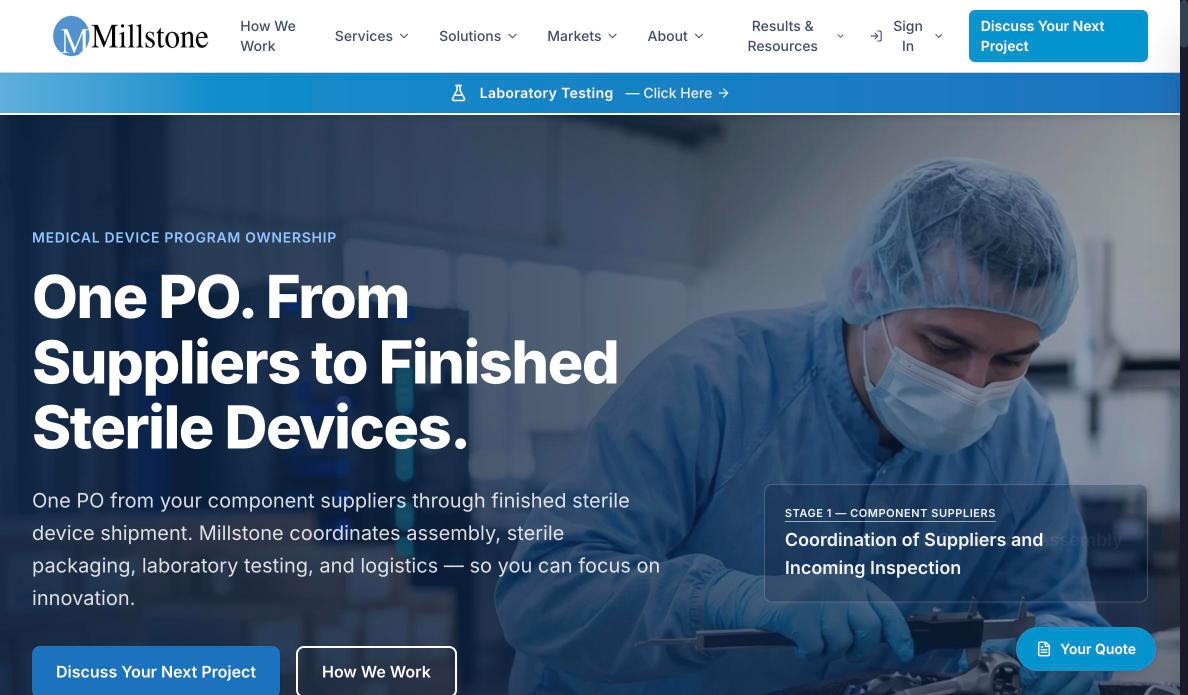
A clear message makes all of this easier. With Millstone we landed on “one PO”: one purchase order for work that usually takes several suppliers. Every email, page and booth conversation now points back to it. Karl Neuberger, Millstone’s CEO, explains why it matters in his interview with The MedTech Digest, our own publication.
More engineers now also ask ChatGPT or Google’s AI which suppliers can handle a given process. Being named in those answers is part of being found, and it is why we treat search and AI visibility as part of lead generation. Trade shows still matter too, and they pay off when the outreach starts weeks before you set up the booth. We plan shows that way.
What we measure
Email opens and clicks tell you very little. We count conversations with people at your target accounts and follow which of them turn into programs. You see that every month in a report and in the shared plan we keep with you.
Once the conversations start, the work moves to sales. I cover that stage in what happens after marketing hands over a lead, and the channels themselves in medical device digital marketing.
If you want to start on your own, write down the OEMs you most want to work with over the next two years, by name. Then look at what their engineers find when they search for your company. We can do that second part for you: our free digital footprint audit takes five business days and ends with a 30 minute call.
Questions manufacturers ask me
Do you use purchased lists?
No. We use a B2B contact database to find the right roles at your target accounts, verify each contact, add your own CRM and trade show contacts, and send small, tailored batches.
How soon does it produce meetings?
It depends on your sales cycle and how well known you already are. The first month goes into targets, messages and setup. From there we report every month on replies, meetings and the accounts they come from.
Is this different from lead generation for a device company?
Yes. A device company sells to surgeons, hospitals and distributors. A manufacturer sells to the OEMs that make the devices, so the people you reach sit in engineering, sourcing, quality and operations, and the message is about what you can make and how reliably you deliver it.
Where to go from here
I spent 14 years on the OEM side, launching and building two MedTech companies, before I started MedTech Momentum in Orlando in 2014.